


What is a vibrator and what do you use it for?
A vibrator is a tool used to compact newly poured concrete mortar from the inside out. When pouring concrete, air can become trapped in the mortar. This ensures that the concrete is not a solid mass. Because trapped air can make the concrete porous, the air must be removed before the concrete mortar cures. With a vibrating seam, you can remove the air bubbles from the concrete mortar on site. This is also known as “concrete compaction.
The process of “compacting concrete with a vibrator” is explained in detail below.
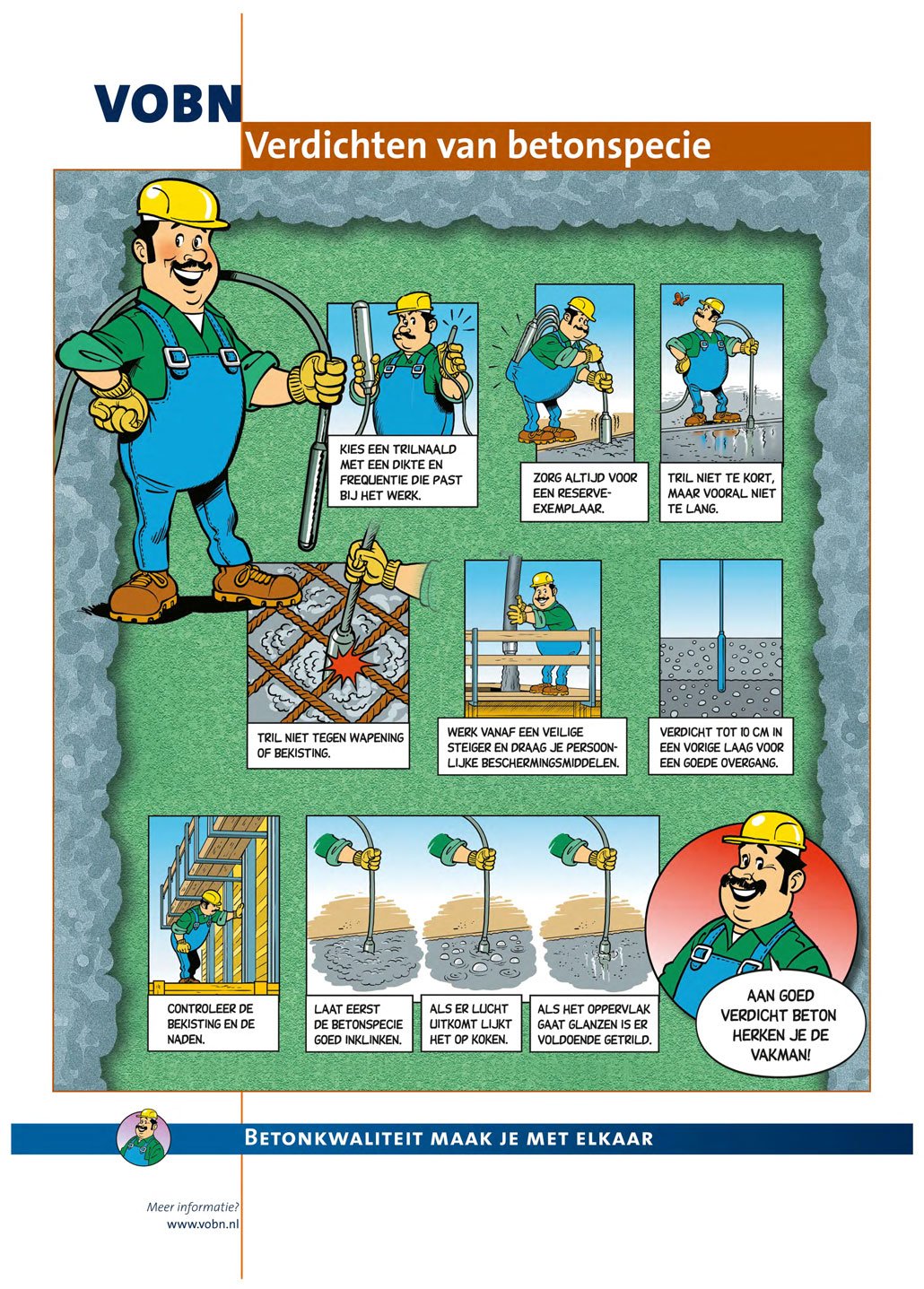
.
Compacting concrete with a vibrator
During the pouring of concrete, air bubbles are entrained. As a result, cavities form in the concrete itself and between the concrete and the formwork wall. When vibration occurs in the freshly poured concrete, air will be expelled. This creates a dense structure.
We can compact concrete with a vibrator or vibrating trowel. In addition, there are a number of other techniques that are listed below.
Concrete is composed of different parts, each with its mass. Under the influence of gravity, when concrete is compacted there is a tendency for segregation: the heavier particles (the coarse gravel) want to settle. However, the internal friction of the aggregate counteracts this interference. And the greater the internal friction, the less is the segregation. However, compaction decreases internal friction, thus increasing the tendency for segregation.
Therefore, concrete compaction requires attention and care.
Compacting concrete and the different methods
To properly compact concrete, there are a large number of methods at hand, each with its own intensity. To compact the concrete mortar at the construction site, the vibratory method in particular is used. The solids in the concrete are put into a very fast back-and-forth motion resulting in a very sharp decrease in internal friction. Shaking, centrifuging, pressing, rolling and the use of vibrating tables are methods used only in the concrete products industry. In summary, the compaction methods are:
- vibrating needles
- surface vibrators
- formwork vibrators
- vibrating tables
- shaking, centrifuging, pressing and rolling
- a pestle (stamping concrete)
- do not vibrate (self-compacting concrete)
On-site compaction of concrete using a vibrator
To compact the concrete poured on site, a vibrator is often used. A vibrator is a hollow metal cylinder in which rotating unbalance is inserted. The vibrating needle is dipped into the concrete, transferring the vibration energy directly into the concrete.
If you look at concrete vibrators, you will see that there are several types:
– Hand stick vibrators
– High-frequency vibrating needles
– High-frequency vibrating needles with integrated transducer
– Honda powered poker vibrators
To compact the coarser parts of the concrete, use low frequency. In this regard, the handstick vibrating needle is suitable. The design and considerations of working conditions and energy make the mechanical handstick vibrators suitable for short-term use up to approx. 60 minutes continuous. A hand-pole vibrator is thus ideally suited for concrete structures of limited size such as residential floors, small formwork and piers.
On the contrary, if you want to compact the finer parts and create a smooth even concrete surface, use a vibrator with a high vibration frequency. These so-called high-frequency vibratory needles are used in conjunction with a high-frequency inverter. Thanks to its special construction, a high-frequency vibrator is ideally suited for very long-term use for up to 10 hours continuously.
We also have high-frequency vibrating needles with built-in inverter. With these vibrating needles, the high-frequency inverter is built in, eliminating the need for a separate inverter.
The range of a vibrator depends, among other things, on the workability of the concrete, the vibration time and the vibrating force of the vibrator used.
Vibrating needles can be ordered in various diameters and hose lengths. The most commonly used size is 45mm or 58mm.
With a handstick vibratory needle, the most commonly used size is 38mm.
How do you use the vibrator after pouring the concrete?
To prevent the inclusion of air bubbles, it is first necessary to pour the concrete in a metered and systematic manner. This can be done using a concrete tub or a concrete pump, which allows you to distribute the concrete mixture over the surface. For further even distribution, it is recommended to use a concrete rake.
Then use a vibrator to compact the concrete in a regular pattern and at short intervals. Thus, the vibrator should not be used to spread piles of concrete mortar. Indeed, this can lead to segregation and thus loss of quality.
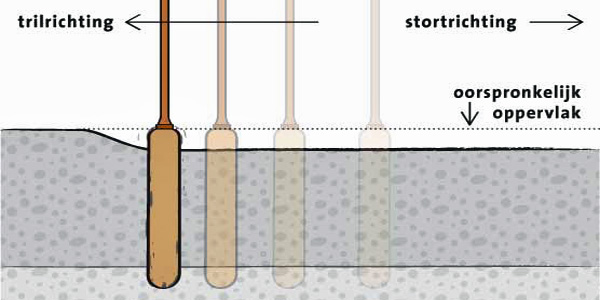
The vibrator should be inserted vertically into the concrete at all times. The vibrating bottle develops heat during vibration and must be cooled. Therefore, the entire vibrating bottle should be placed as far into the concrete as possible so that the vibrating needle can transfer its heat to the concrete. If you want to compact a relatively thin floor, you will see that the vibrating bottle protrudes a portion above the surface. Therefore, a vibrator with short vibrating bottle is definitely recommended.
While compacting concrete using a vibrator, the concrete mixture sounds and you will see air bubbles appear on the surface. When you see that the concrete begins to show a shiny layer, it is time to remove the vibrator from the concrete mixture. However, do this with caution because if you pull the vibrating needle out of the concrete too quickly, hollows can reappear.
Which diameter vibrator is suitable for which job?
The diameter of the vibrator largely determines the impact force of the vibrator and the size of the area the vibrator can compact at one time. Looking purely at the thickness of the vibrator, one would naturally think that a thick concrete vibrator with a diameter of 65 mm would probably be the most sold vibrator. After all, everyone wants to be able to compact the concrete as quickly as possible, and so with more impact force, it will also start to take less time.
In practice, it all works a little differently. This is because the thickness of the chosen vibrator depends on the following three factors:
- The distance between rebar
To reinforce the concrete against tensile stresses, steel reinforcement bars are placed in the concrete formwork. These rods must not be touched by the poker-vibrator, as this could damage the reinforcement and the poker-vibrator. As a result, fine mesh reinforcement often uses a smaller bottle diameter. - The shape to be vibrated (floor, thin wall or a thick wall)
The area a vibrating needle can reach is about 8 times the diameter of the bottle. For a vibrating bottle with a diameter of 65 mm, this corresponds to a sphere (not a circle!) with a diameter of 520 mm. Now, if you are dealing with a floor of a small thickness (less than 30 cm), it does not make much sense to use such a thick vibrating needle, because a lot of vibration energy will be reflected by the substrate.
Moreover, this can cause excessive compaction, which in turn can cause de-mixing of the concrete mixture. The same phenomenon can also occur, for example, with wall formwork; the vibrating waves are then reflected by the wall formwork and this, too, can cause on-site segregation of the formwork.
The advantage of the larger area that the 65-mm-thick vibrator can compact at once compared to a smaller-diameter concrete needle is also negated by the higher weight of the vibrator. In that case, the ease of use of a lighter vibrator then weighs much more heavily in deciding which diameter concrete vibrator to use. - The composition of the concrete
Because the impact force of the vibrator largely depends on the diameter of the vibrator, it is important to consider the composition of the concrete mix in your choice of the right vibrator. In general, you can say that the stiffer the concrete mortar is, the more impact force will be required to compact the mixture. For example, if one is using special, earth-moist concrete, then a 65-millimeter-thick vibrator may sometimes be the only concrete vibrator that can make concrete compaction possible. However, on the other hand, if this needle is used in a very plastic concrete, segregation can occur very quickly because of the high vibration force.
The number of concrete workers to be used with a vibrator depends on the power and frequency; per hour, a concrete worker can compact 3m3 to 12m3 of concrete. View the table below to see the average effective compaction of the vibrator: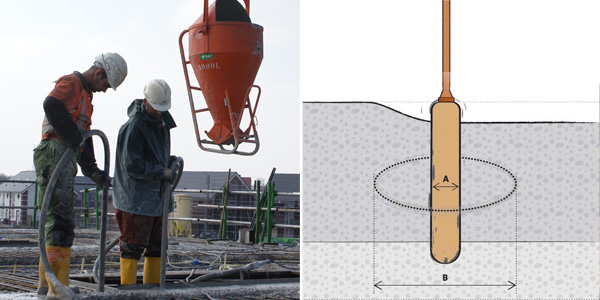
There is a direct relationship between the cross-sectional area of the vibrating needle (A) and the area around the vibrating needle being compacted (B)Vibrating needle diameter (A) Effective compaction (B) Approx. 28 mm Approx. 300 mm Approx. 38 mm Approx. 400 mm Approx. 50 mm Approx. 550 mm Approx. 58 mm Approx. 750 mm Approx. 65 mm Approx. 900 mm
What is the distance between the vibration points?
When compacting concrete, you can’t just stick the vibrator into the concrete and go about your business. This is because you need to take into account the distance between the points where you insert your vibrating needle into the concrete, called vibration points. The distance between these vibration points depends on the range of the vibrator used. It is recommended that the distance be as small as possible. After all, it is better to have a short vibration time and a small distance between the vibration points than to choose a long distance and a long vibration time.
When vibrating, do not dip the vibrator deeper than 300 to 500 mm into the concrete. If the concrete vibrator is even shorter, then only the vibrating bottle should disappear into the concrete mixture. In the interest of homogeneity, the needle should enter 100 to 150 mm into the underlying, already compacted layer.
Compacting concrete with a vibrating beam or vibrating trowel
To quickly and easily vibrate large areas of freshly poured concrete, you might consider using a so-called vibrating beam, vibrating trowel or surface vibrator. The disadvantage of a vibrating beam or vibrating trowel is that it transmits the vibrations in the most unfavorable place, which is on the surface of the concrete. Therefore, these machines have a low depth effect and are only suitable for compacting horizontal sections of limited thickness. Consider, for example, concrete floors or yard paving.
Because gravity plays a particularly large role in concrete compaction, a vibrating beam or vibrating trowel will be able to enable much lower compaction. For example, vibrating beams and vibrating shovels are capable of compacting the concrete to a depth of about 20 centimeters. Of course, this does depend on the model of vibrator and the composition of the concrete.